
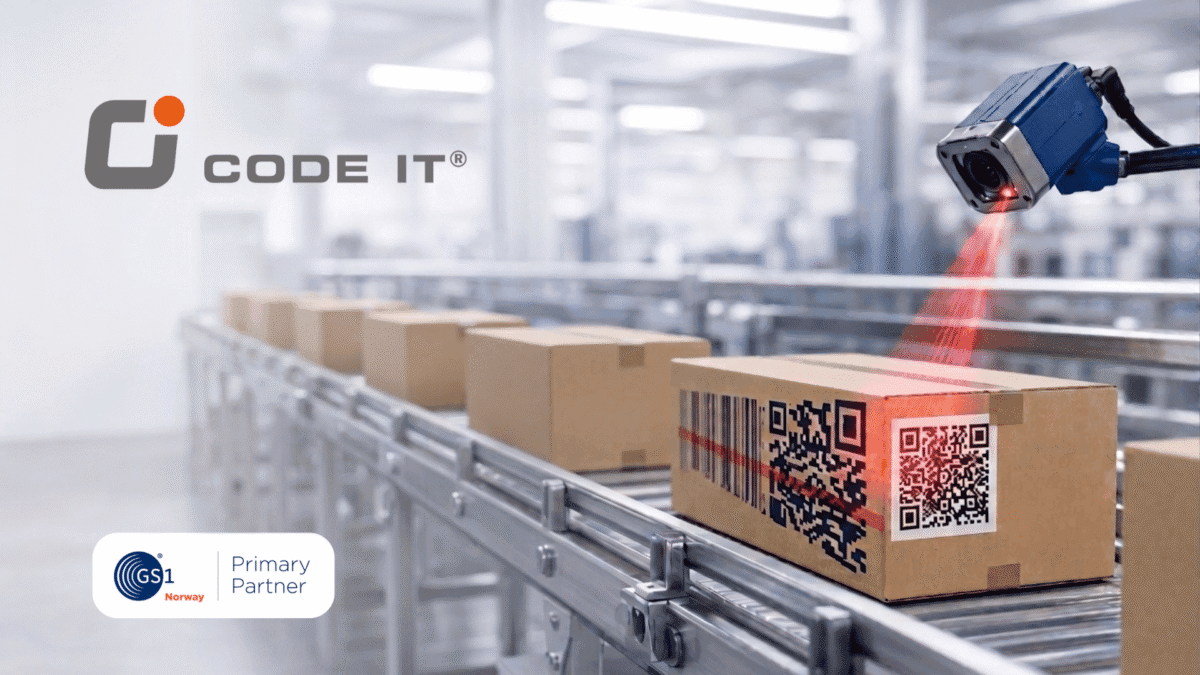
🟠GS1 Sunrise 2027: What It Means for Your Packaging Line
GS1 Sunrise 2027 is the global retail industry's transition date by which point-of-sale systems must be able to scan 2D barcodes — such as QR codes and DataMatrix codes — alongside traditional 1D barcodes.
For manufacturers producing packaged food, fish, or other consumer goods, this means packaging, labelling, and traceability systems need to support 2D barcode generation and verification before the end of 2027.
This is a requirement set by GS1, the global standards organisation behind the barcode system used in retail worldwide. Major retailers are already preparing checkout infrastructure.
What's Actually Changing
Today, almost all retail packaging carries a 1D barcode encoding a single product identifier. Sunrise 2027 doesn't remove that — it adds a requirement: point-of-sale systems will be expected to read 2D barcodes too, and brand owners are expected to be ready to provide them.
A 2D barcode can carry significantly more information than a 1D barcode in the same space: not just a product identifier, but batch number, expiry date and serial number, all in a single scan.
Why This Matters More for Food and Fish Producers
For food and fish manufacturers, 2D barcodes aren't just a retail convenience — they're a traceability upgrade. The additional encoded data directly supports the kind of granular tracking that food safety regulation increasingly requires, and that recall processes depend on.
The barcode is only as good as the data behind it. If production and traceability systems aren't generating accurate batch and lot data in real time, the 2D barcode encodes incomplete or incorrect information — which defeats the purpose.
What to Check Before the Deadline
- Marking and labelling hardware: Can your printers and applicators generate 2D barcodes at production speed, alongside your existing 1D barcode?
- Data structure: Is your production and traceability data structured to the GS1 standard (GTIN, batch/lot, expiry, serial number) so it can populate a compliant barcode?
- System integration: Do production, ERP and labelling systems share data in real time, or does it move manually between them?
- Verification: Do you have a way to verify printed 2D barcodes are readable and correctly encoded before products leave the line?
A Realistic Timeline
Sunrise 2027 sounds distant when it's still well over a year away, but the work involved is rarely just a software update. Hardware may need reconfiguring, master data often needs cleaning up before it can populate a compliant barcode correctly, and testing against real retail scanning systems takes time.
Manufacturers who start now have time to test, adjust and roll out gradually. Those who wait until 2027 will be doing it under pressure, against a fixed deadline they can't move.
How CodeIT Approaches Sunrise 2027 Readiness
Sunrise 2027 sits at the intersection of production data, marking systems and traceability — three things CodeIT works with directly across food, fish and wood manufacturing, with GS1 framework usage already confirmed in production at customers. Readiness usually starts with one question: is your underlying production and traceability data clean and structured enough to support a compliant 2D barcode in the first place? Getting that foundation right makes the barcode the easy part.
Frequently Asked Questions
When exactly does GS1 Sunrise 2027 take effect?
Sunrise 2027 refers to the end of 2027, by which point major retailers' point-of-sale systems are expected to suport 2D barcode scanning at checkout. Exact regional timelines vary, so manufacturers should check guidance from their local GS1 member organisation.
Do I need to remove my existing 1D barcode?
No. The current approach runs 1D and 2D barcodes alongside each other during the transition, so retail systems that haven't upgraded yet can still scan products normally.
What can a 2D barcode hold that a 1D barcode can't?
A 2D barcode can encode batch or lot number, expiry date, and serial number in addition to the standard product identifier — data that supports far more precise traceability and recall management.