
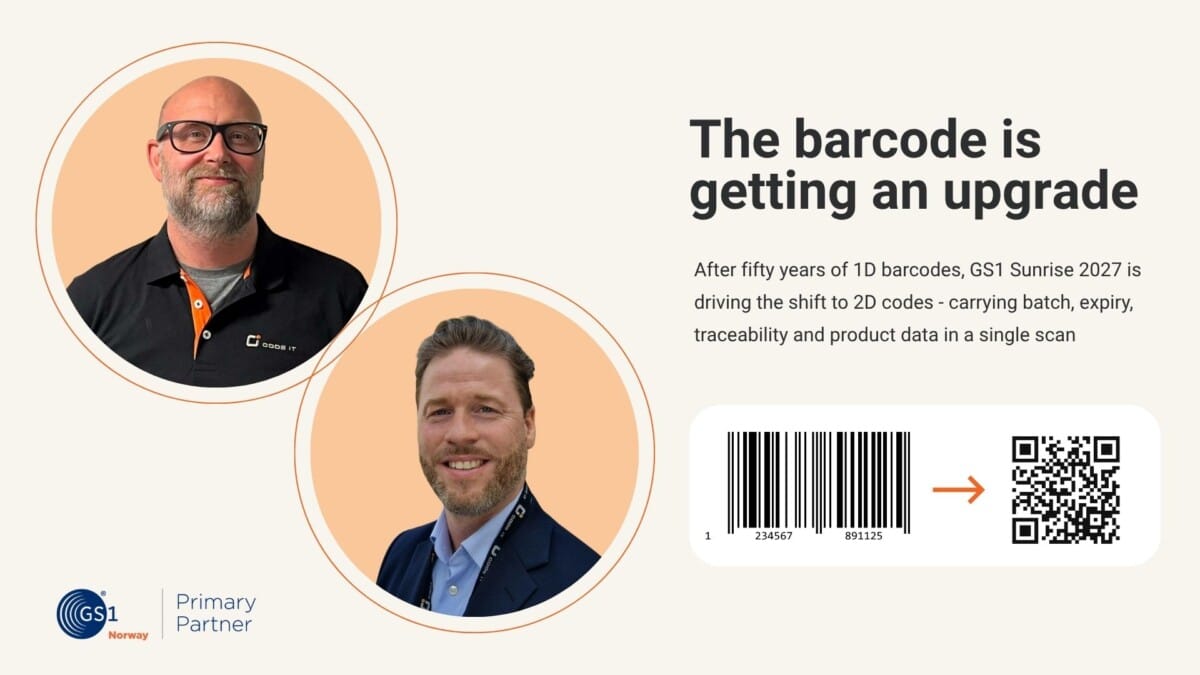
🟠 GS1 Sunrise 2027: What the Shift to 2D Barcodes Means for Manufacturers.
GS1 Sunrise 2027 is a global initiative to transition from traditional one-dimensional barcodes to 2D barcodes - such as QR codes and GS1 DataMatrix - across retail and supply chain systems worldwide.
For manufacturers, this shift brings new opportunities in traceability, data sharing, and regulatory compliance, but it also raises important questions about operational readiness.
CodeIT is heading to the GS1 Nordic Summit in Oslo on May 7–8 as a proud GS1 Norway Primary Partner. Here's a look at what the transition involves and why it matters.
From 1D to 2D: What's changing?
The familiar one-dimensional barcode has been the backbone of product identification since 1974. It carries a Global Trade Item Number (GTIN) - essentially a product ID used for price lookup at checkout. That's about all it can do.
2D barcodes are different. A single QR code or GS1 DataMatrix can hold batch numbers, expiration dates, serial numbers, and even URLs linking to real-time product information. Where a 1D barcode stores around 13 digits, a 2D code can carry thousands of characters.
The goal of GS1 Sunrise 2027 is for retail point-of-sale systems worldwide to be capable of scanning and processing these new codes by the end of 2027. The transition is already underway, with pilots running in 48 countries.
What does this mean for manufacturers?
For manufacturers, the implications go beyond swapping one barcode for another. 2D barcodes introduce richer, more dynamic data requirements on the production line. That means production systems - from labeling equipment to data management - may need to evolve to support the new standard.
Some of the key areas affected include traceability across the supply chain, where serialized data enables more precise tracking and targeted recalls. Regulatory compliance is another factor, as industries like food and pharmaceuticals face growing requirements for product transparency. There's also consumer engagement to consider. A single scan from a smartphone can give consumers access to product origin, sustainability credentials, and usage instructions.
During the transition period, GS1 recommends that manufacturers add 2D codes alongside existing 1D barcodes on packaging, ensuring compatibility while systems are upgraded.
GS1 Nordic Summit 2026: A Nordic perspective
The GS1 Nordic Summit brings together decision-makers and technology experts from across the Nordics to explore how global standards, data quality, and cross-industry collaboration can drive digital transformation and sustainable growth. This year's theme is Navigating Trade in a New World Order.
The programme features speakers from companies like IKEA, H&M, and NorgesGruppen, covering topics from supply chain transparency to practical experiences with QR codes built on GS1 standards.
Meet CodeIT at the summit
CodeIT will be at the GS1 Nordic Summit with a stand. Whether you're already preparing for GS1 Sunrise 2027 or just starting to explore what 2D barcodes mean for your operations, we'd love to have a conversation.
GS1 Nordic Summit, Oslo, May 7–8, 2026, Radisson Blu Plaza
